"When It's Easy, It's Fun!"

Showing posts with label Chord Voicings. Show all posts
Showing posts with label Chord Voicings. Show all posts
Wednesday, November 13, 2013


Friday, April 22, 2011
Piano Lessons: Tip 2:
Chord Voicings: Chords For A Better Sound
http://www.easypiano.com
http://twitter.com/easypiano
In this Free Piano Lesson for beginners to intermediates, you will learn how to take a chord and split it between hands to get the same sounds professional musicians get.
You will be introduced to the concept of Chord Voicings.
This is a preview of the concept taught in my Chord Voicings, Phase II program. http://bit.ly/gsnIle
Everything is kept easy so it will be fun to learn
http://twitter.com/easypiano
In this Free Piano Lesson for beginners to intermediates, you will learn how to take a chord and split it between hands to get the same sounds professional musicians get.
You will be introduced to the concept of Chord Voicings.
This is a preview of the concept taught in my Chord Voicings, Phase II program. http://bit.ly/gsnIle
Everything is kept easy so it will be fun to learn
Monday, February 9, 2009
How To Get A More Interesting Sound From Your Chords
by Charley Wyser
When you listen to professional musicians play, you may notice that their chords sound different from the way you are first taught to play chords.
Why is this?
Why is this?
Many professionals have learned to use voicings. What is a voicing?
This is when you rearrange the notes of the chords you play, usually between hands.
Let's take a simple C chord. The notes in a C chord are C, E, and G - 1, 3, and 5, of the C Major scale.
To make things easier, we are going to use the intervals (tones on the Major scale) to refer to voicing the chord.
Let's open up the sound of this chord by playing two of the three notes in the left hand, and the other note in the right hand.
Let's refer to this as the 1 - 5 - 3 voicing.
In other words, the left hand will play the 1 and 5 (C and G), and the right hand will play the 3 in the next register higher.

When you get a minute, try playing a regular C chord in root position (C, E, G), and then try playing this 1 - 5 - 3 voicing of the C chord on the piano.
You will notice the 1 - 5 - 3 has a more "open" sound. It does not sound as crowded. Personally, I prefer this sound.
Now, try this with the C minor, C Augmented, and C diminished chords.
C minor: 1 - 5 - b3 voicing

C Augmented: 1 - #5 - 3 voicing

C diminished: 1 - b5 - b3

You can see that these chords are now sounding more interesting.
This is how professionals play their chords.
We used 3 note chords for our examples in this lesson. But, you will usually apply this voicing concept to chords consisting of 4 or more notes.
The secret is remembering which numbers on the scale (intervals) the chord you are trying to voice is based on.
Experiment with this a little bit so you can understand the concept.
To learn how to play the 1-5-3 voicing in all twelve keys and apply to songs, take a look at my program called "Chord Voicings - Phase I".
Until next time, continue to have fun on your piano adventures.
Charley Wyser
easypiano.com
To view Free Online Lessons, click here
This is when you rearrange the notes of the chords you play, usually between hands.
Let's take a simple C chord. The notes in a C chord are C, E, and G - 1, 3, and 5, of the C Major scale.
To make things easier, we are going to use the intervals (tones on the Major scale) to refer to voicing the chord.
Let's open up the sound of this chord by playing two of the three notes in the left hand, and the other note in the right hand.
Let's refer to this as the 1 - 5 - 3 voicing.
In other words, the left hand will play the 1 and 5 (C and G), and the right hand will play the 3 in the next register higher.
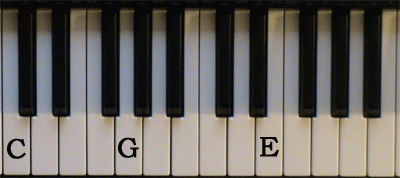
When you get a minute, try playing a regular C chord in root position (C, E, G), and then try playing this 1 - 5 - 3 voicing of the C chord on the piano.
You will notice the 1 - 5 - 3 has a more "open" sound. It does not sound as crowded. Personally, I prefer this sound.
Now, try this with the C minor, C Augmented, and C diminished chords.
C minor: 1 - 5 - b3 voicing
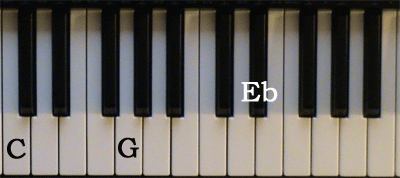
C Augmented: 1 - #5 - 3 voicing
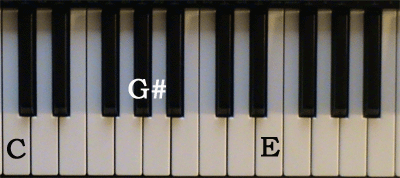
C diminished: 1 - b5 - b3
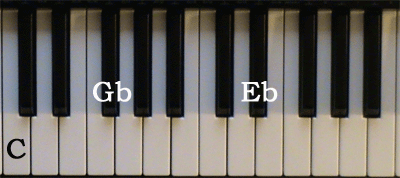
You can see that these chords are now sounding more interesting.
This is how professionals play their chords.
We used 3 note chords for our examples in this lesson. But, you will usually apply this voicing concept to chords consisting of 4 or more notes.
The secret is remembering which numbers on the scale (intervals) the chord you are trying to voice is based on.
Experiment with this a little bit so you can understand the concept.
To learn how to play the 1-5-3 voicing in all twelve keys and apply to songs, take a look at my program called "Chord Voicings - Phase I".
Until next time, continue to have fun on your piano adventures.
Charley Wyser
easypiano.com
To view Free Online Lessons, click here
Subscribe to:
Posts (Atom)


 Posts
Posts

